On this page
Stage 1: Assign agents familiar rolesStage 2: Share task context in a common recordStart with a small experimentA task card carries the context forwardStage 3: Coordinate agents around an outcomeWe are still making adjustmentsStarting in March 2026, I gradually set up more than a dozen agents, each performing different tasks.
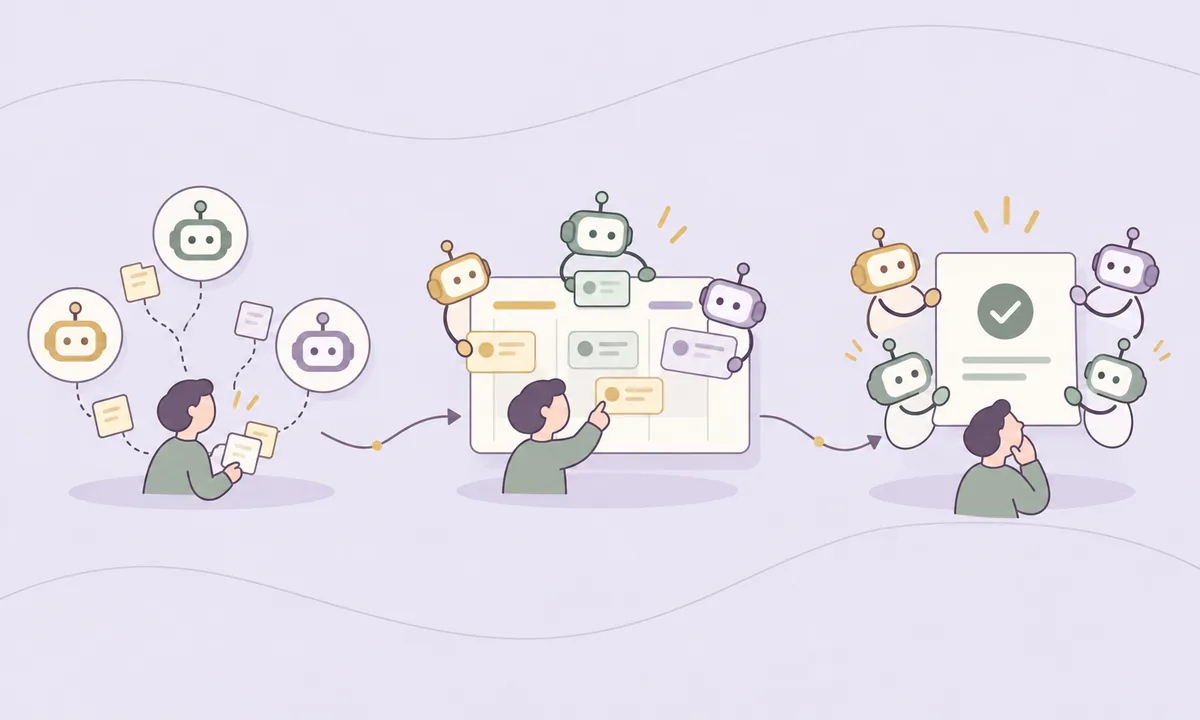
Looking back, the biggest change has been the way I organize their work. At first, I used the company roles I knew. Later, I focused on task workflows and shared information. Eventually, I began organizing agents around the collaboration needed to produce work we could actually use.
The process unfolded in three stages.
Stage 1: Assign agents familiar roles
At first, I drew on the roles I knew from my previous work.
Some agents handled learning materials and documentation, some prepared development plans, and others wrote the code. A deployment agent took over when the code was ready. After launch, a data analysis agent compiled traffic, user counts, and click events into a daily report.
The setup was easy to understand. Each agent had a clear role, and I assigned work accordingly.
But in practice, a problem quickly arose: every agent was waiting for me to assign the next step.
Whenever I had an idea, I had to decide which agent should start. Once the proposal was ready, I found the development agent, explained the background, and passed on the materials. After development, I found the deployment agent and explained where the project was, which technologies it used, and how to run it.
It felt as though they were all sitting at their desks, waiting for me to walk over and assign the next task.
I began spending more and more time checking: Who is handling this now? Has the previous step been completed? What information is the next agent still missing?
We had divided up the work, but almost every handoff still fell to me.
Stage 2: Share task context in a common record
Later, I started using shared databases and kanban boards to organize this work.
The first thing to change was the way I recorded my thoughts. Whenever I was reading a book, talking to someone, or trying an interesting product, I could send an observation to the agent that kept my notes.
It created an idea card: what I had noticed, who might face a problem and in what circumstances, and which assumptions I wanted to explore. The idea did not need to be fully formed to be worth recording.
Next, I handed the card to the agent in charge of research. It checked the market for similar products and the solutions others were using, then provided relevant information and analysis.
The card then held both my observations and the research agent’s findings. Each of us contributed information that the next stage could build on.
Start with a small experiment
Just because you’ve done your research doesn’t mean you have to develop the entire idea all at once.
Inspired by the Lean Startup approach, I began identifying the assumptions most worth testing and designing the smallest useful experiment.
We began recording ideas and experiments separately. The experiment-design agent proposed a first step: who to serve, which problem to solve, and how to test whether the approach worked.
For example, for a complete product concept, the first step might simply require a web page capable of uploading documents, converting formats, and exporting them. Login, registration, and other features that aren’t needed for now can be left for later.
Write these details clearly on the experiment card before handing it over to the development agent. It will set up the project, implement the features, and add the code repository and technical specifications to the record. Once the deployment agent receives the card, it can proceed with the work based on this information and then add the access URL and deployment results.
After launch, the data analysis agent will continue to track the experiment’s performance to provide a basis for the next round of adjustments.
A task card carries the context forward
The changes brought about by this approach are straightforward: I no longer have to retell the entire story every time there’s a handoff.
Agents joining the project later can use the links between ideas and experiments to locate the original problem, supporting research, scope of the work, code repositories, and improvements that have already been attempted.
At first, the record may contain only an idea I proposed. As the work progresses, other fields will be filled in by different agents, eventually forming a record of how the task developed.
The kanban board also makes it easier for me to see which tasks are still in the research phase, which have entered development, and which have already been launched and need follow-up. I move the cards to the next stage and then assign them to the appropriate agent.
At that stage, I still had to assign many tasks myself. Keeping shared records reduced repeated explanations and gave each handoff more complete context than copying messages from one chat to another.
This made me realize that when organizing a team of agents, in addition to defining each agent’s responsibilities, it’s also necessary to carefully design a shared record of work that everyone relies on.
Stage 3: Coordinate agents around an outcome
Later on, a new problem arose.
On some tasks, a single agent seemed able to do everything, yet the final result kept falling short. Making the prompt longer did not reliably improve it.
So, I began to reorganize these tasks.
Take market intelligence gathering, for example. Initially, one agent had to find relevant material, read it, filter it, and assess its business value. Later, I broke this task down into two separate steps.
The first agent gathered material from websites and other sources across our areas of interest. The second assessed it against our current work, earlier questions, and what we already knew, then identified what was worth investigating.
By separating data collection from evaluation, it’s easier to identify where the problem lies: was the information insufficient, or were the filtering criteria unclear? Subsequent adjustments can also be more targeted. Based on our own experience using the system, the results are now closer to our expectations than before.
Similar changes have also occurred in e-commerce-related work. A product listing task might include promotional images, product descriptions, titles, cover images, and pricing arrangements. When all of this is assigned to a single agent, issues such as slow turnaround times and inconsistent quality across different stages often arise.
We began adding tools for each stage, clarifying responsibilities, and checking how the stages worked together to produce a finished result.
At this point, my concerns have also shifted: To what extent must a task be completed to be considered finished? Which parts require different skill sets? Who checks the work, and where should it be sent back for revisions if issues are found?
We are still making adjustments
There are no clear boundaries between these three stages. In our team today, role-based assignments, shared task records, and collaboration among multiple agents still coexist.
Nor has this turned me into someone who merely comes up with ideas. I still spend a lot of time adjusting the agents’ workflows, selecting tools, checking results, and coordinating how they work together to get things done.
However, these practices have made it increasingly clear to me that some repetitive work can be gradually reduced. Background information that has already been documented should not have to be rehashed every time; feedback that has already appeared in the deliverables should be forwarded to whoever is responsible for making the changes; and the results of the previous step should serve as a reliable starting point for the next step.
CoLand was born out of these specific needs. We first tried to bring feedback from collaboration tools back into the original agent conversation, allowing work that had already been delivered to continue moving forward.
As for how the entire team can collaborate more independently and consistently, we are still experimenting and will continue to document the practical challenges we encounter and the adjustments we make along the way.
For an introduction to CoLand and where we’re heading, watch our launch film.